Redefining Performance in the AI Era

Redefining Performance in the AI Era

The new performance frontier for AI-enabled firms

Artificial intelligence is reshaping the rules of competition, but contrary to popular belief, the true battleground isn’t technology itself – it’s performance. In an era awash with powerful algorithms and endless pilots, companies are learning a hard truth: simply deploying AI solutions means little if they don’t translate into better outcomes. Performance – not technology – has become the central strategic goal of AI transformation. Organisations that thrive are those that harness AI to dramatically improve productivity, learning, speed and innovation, not just those that accumulate the most algorithms.

Performance Over Technology: AI’s Strategic North Star

Every technological revolution in business eventually comes down to one question: does it make us perform better? AI is no exception. Amid the excitement of deploying machine learning models, generative AI or AI agents, leaders are realising that technology for technology’s sake is a dead end. The organisations pulling ahead are those treating performance gains as the primary objective of AI initiatives – using the technology as a means to an end (better outcomes), not the end itself.

Many boards invest in AI hoping to boost knowledge-worker efficiency, but without a structured plan to realise value; tools are deployed but value is not realised. Success with AI requires starting with a performance mindset – defining, or at least hypothesising, upfront how an AI solution will change outcomes like productivity, quality, or speed, and then rewiring roles and processes to capture that “productivity dividend” in the P&L. In practice, this means AI at scale must be treated as a business transformation, not a series of software integrations.

Leading companies are therefore making performance impact their North Star for AI. They structure AI programs under executive sponsors who tie projects to strategic goals and measurable results. They avoid piloting AI in isolation; instead, they plan from day one how new AI capabilities will embed into workflows, how employees will adopt them, and how value will be tracked. This focus on performance is not anti-technology – it’s what ensures technology actually matters.

Redefining Performance in the AI Era

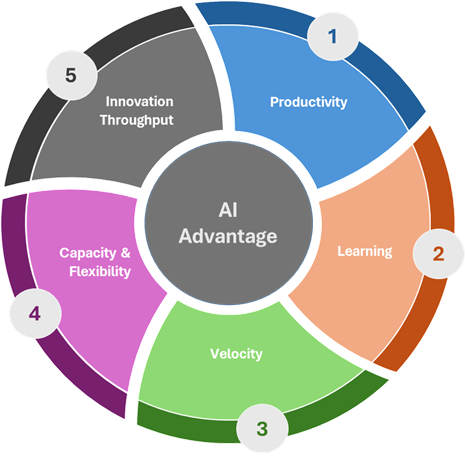
What does “performance” mean in an AI-driven organisation? Traditionally, we measured performance with straightforward efficiency and financial KPIs – output per worker, profit margins, growth rates, etc. Those measures remain important, but the AI era is expanding the very notion of performance. Leading organisations now define performance as a multidimensional, continuously evolving target that blends productivity with less tangible but critical capabilities like learning and innovation. As illustrated in figure 1 below, five elements form the new performance frontier for AI-enabled firms creating and sustaining an AI advantage: productivity, learning, velocity, capacity & flexibility, and innovation throughput.

Figure 1: AI Performance Measurement Framework
Source: Technology Connect

Productivity: AI’s first and most immediate contribution is often in productivity – automating routine work, augmenting employees’ capabilities, and removing bottlenecks. In the AI era, productivity gains are not incremental but exponential. A single AI-driven system can do the work of dozens of people or empower one employee to have the impact of many.

Learning: Perhaps the most defining feature of AI-enabled firms is that they are “learning engines”. They treat performance as a moving target, constantly improved through data feedback loops and experimentation. In the AI era, a company’s ability to learn quickly – at the individual, team, and organisational level – is a core driver of performance. This goes beyond training programs; it means the organisation as a whole adapts and gets smarter with each AI use case and project.

Velocity: Traditional performance metrics often looked at quarterly or annual outputs. In the AI era, time has become a key performance variable – specifically, how fast an organisation can move from idea to insight to implemented result. “Velocity” in this context means the sheer speed of decision-making, execution, and iteration. AI can compress processes that previously took weeks into days or hours.

Capacity & Flexibility: AI transformation fundamentally changes the economics of scaling a business. When software and algorithms handle core processes, companies can grow with far fewer incremental costs or people. Performance in the AI era thus includes an almost limitless capacity to expand operations and enter new domains – if the models and data support it.

Innovation Throughput: Finally, AI is turbocharging innovation itself – not just in tech companies, but across industries. Innovation throughput refers to the rate at which an organisation can generate, build, test, de-risk, and implement new ideas or improvements. In the past, innovation was often constrained by human bandwidth and lengthy R&D cycles. AI changes that by automating parts of research (for example, scanning vast data for patterns), by enabling simulation and virtual experimentation, and by facilitating rapid prototyping (think AI-assisted design). The result is that a company’s “innovation engine” can run much faster.

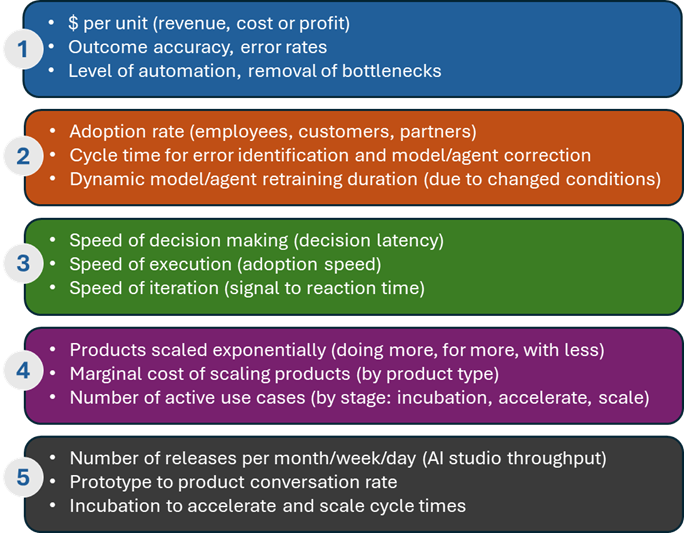
As an example of how to operationalise the AI Performance Measurement Framework, Table 1 below provides an example of AI performance metrics across the five dimensions:
Source: Technology Connect

In Summary

In blending these five dimensions, performance in the AI era becomes a rich tapestry. It’s no longer captured by a single metric on a monthly report. A truly high-performing AI-driven organisation might be, for instance, simultaneously cutting manual effort by 30%, doubling its speed of feature development, scaling to serve 5x more customers, and learning from every interaction to refine its services. These facets reinforce each other: increased capacity enables more data and learning; faster velocity enables more innovation experiments; innovation creates new revenue that boosts productivity metrics, and so on. Importantly, some of these elements (like learning and innovation) are more intangible – they may not show up in traditional quarterly numbers, but they are what ensure the organisation’s performance keeps improving over time. Executives, therefore, must expand their mental model of what to monitor and manage to create and sustain an AI advantage.


If interested in exploring how to develop or refine your organisations AI Performance Measurement Framework, then connect with us.

Tom Dissing is the founder and Managing Director of Technology Connect. He has deep expertise in helping companies digitally transform and scale their businesses through better, faster and smarter use of emerging technology and optimising value from ecosystems of supplier capabilities. Tom is a trusted advisor to procurement, technology and finance executives and senior management teams. He has advised senior executives in Financial Services (Banking, Insurance, Wealth and Superannuation), Media & Entertainment, Construction & Engineering, Technology Services and Government (Federal and State) in Australia, New Zealand, Asia and Europe.

Copyright © 2025 Technology Connect. All rights reserved.


The AI Venture Factory Operating Model

The AI Venture Factory Operating Model

An operating model for incubating and accelerating inovative AI ventures and supercharging growth

Most companies stand at a pivotal crossroad in an era of profound transformation. Significant pressures on economic growth and competitiveness, driven by new Artificial Intelligence (AI) products and experiences, whilst navigating risks of geopolitical volatility and new regulation. In this new AI era, companies can choose to lead with ambition and purpose — or risk being left behind.

AI is no longer a futuristic concept but a present-day catalyst for innovation, competitive advantage and continued relevance. From generative AI (Gen AI), which creates new content and insights, to applied AI, which integrates these capabilities into products and operational processes, organisations that strategically leverage AI will continue to outperform their peers.

Research indicates that between 2023-2030, greater utilisation of AI in key Australian industries will lead to a short-term boost in GDP of more than AU$200 billion per annum and the creation of 150,000 jobs over this period (Note 1). This transformative potential is evident as companies across various sectors, from finance to healthcare, are reimagining their operations and customer experiences through AI solutions and platforms. From a global banking industry perspective, Gen AI has potential to add US$200 – UA$340 billion in value annually, or 2.8 to 4.7 percent of the total revenues, largely through increased productivity (Note 2).

However, the “flip side” of such transformative potential is that it introduces risk of disruption for all companies. AI is compressing the traditional innovation cycle. What once took months — from ideation to scaled commercialisation — is now occurring in record time.

Within this context, how do companies strategically lead with purpose and ambition? One option is to invest in an AI Venture Factory.

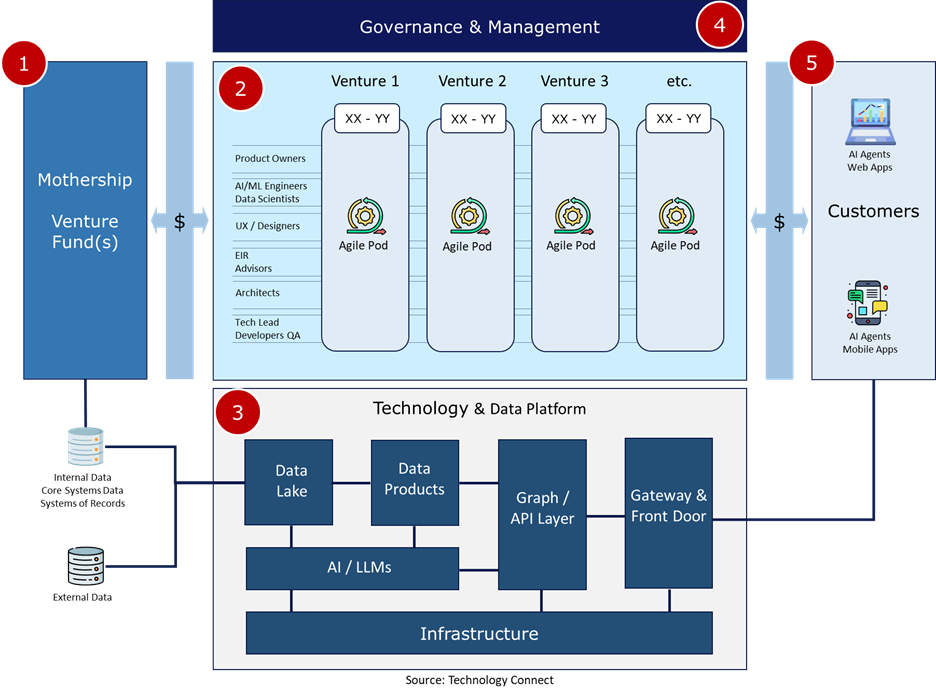
An AI Venture Factory is a company’s ‘startup engine’—where it discovers, builds and accelerates AI ventures from scratch, rapidly prototype new products, and spin in or spin out solutions that can transform the current business or launch entirely new revenue lines driving delivering +10x growth. To bring this to life, Figure 1 below provides an illustration of an AI Venture Factory Operating Model.

Figure 1: AI Venture Factory Operating Model

The AI Venture Factory Operating Model has five main components:

  1. The company “mothership”, and potential external funding sources such as VCs, provides funding to the Factory Ventures.
  2. The funding is being used to establish the people, processes and technology used to build, accelerate, scale and optimise AI products. Each AI venture, and associated AI product, is organised in agile pods. Biweekly sprints are executed to rapidly prototype AI minimal viable products (MVPs).
  3. A technology and data platform supports the agile pods. Strategic technology investments, partnership and architecture decisions are made concerning which LLM(s) to use and what infrastructure is required, e.g., data centre and GPUs. It is also critical to cohesively adhere to principles of being able to re-use data products across AI solutions, e.g. AI Agents, and have microservice APIs.
  4. The AI Venture Factory is governed by the “mothership” sponsor(s) and investment committee, using stage-gated funding release principles. A centralised management function is established to lead execution of the AI Venture Factory. Quarterly business reviews ensure alignment between the “mothership” strategy and OKR expectations.
  5. Finally, the customer pays to use the company’s AI products and services to obtain better, faster and cheaper productiity and experiences, whilst delivering the expected financial return on AI investments to the “mothership” corporation. AI products and experiences are continuously and rapidly improved and released by the agile AI venture pods to drive growth and productivity improvements.

An AI Venture Factory pairs the entrepreneurial hustle of a startup with the resources and reach of the “mothership” corporation, letting companies pilot innovations internally before scaling them for commercial success. It’s a proven way to tap in-house talent, fast-track AI breakthroughs, and stay ahead of emerging trends—all while creating the next generation of growth engines for the company.

We have entered a new era of humanity powered by artificial intelligence. Companies that do not rapidly build and scale their AI capabilities, augment products and experiences, rewire business and operating models are unlikely to be in business by end of this decade. Hopefully your organisation is rapidly incubating and accelerating AI ventures to remain competitive…?

Notes:

  1. Kingston AI Group: Australia’s AI Imperative, May 2024
  2. McKinsey: Scaling Gen AI In Banking: Choosing The Best Operating Model, March 2024

If interested in exploring how you could benefit from building your AI Incubation Factory, then connect with us.

Tom Dissing is the founder and Managing Director of Technology Connect. He has deep expertise in collaborating with companies to digitally transform and scale their businesses through better, faster and smarter use of emerging technology and optimising value from digital ecosystems. He works as a trusted advisor with senior executives in Financial Services (Banking, Insurance, Wealth and Superannuation), Health, Media & Entertainment, Construction & Engineering, Technology Services and Government (Federal and State) in Australia, New Zealand, Asia and Europe.

Copyright © 2025 Technology Connect. All rights reserved.


Six Artificial Intelligence Narratives

Six Artificial Intelligence Narratives

Framing future AI scenarios to understand what they mean, why they matter, and what to do

Artificial intelligence (AI) will save the world! Artificial intelligence will destroy humanity! Apart from the obvious hype and fear mongering, how do we make sense of this, especially when there isn’t a universally accepted, useful and practical definition of AI, investments or adoption. Even global research organisations such as Gartner has created an AI Immaturity Assessment tool, as there is not yet enough evidence of best practices to determine what maturity looks like. In this context, how do companies make good investment decisions, and government good policies and regulation, when the reality is highly complex and uncertain?

AI Rubik’s Cube

When it comes to AI, reality is far more nuanced than just good or bad. It doesn’t just mean one thing—it varies greatly depending on geography, sector and activist. In today’s rapidly evolving technology landscape, understanding AI requires deeper reflection, conversation and collaboration, recognizing its diverse applications and implications across different ecosystems. To harness AI’s full potential, organisations must navigate this complexity, adapting AI strategies that align with their unique needs and environments.

When we enter an era of exponential change our old mental models are no longer reliable guides to our complex and rapidly evolving reality. Narratives provides a tool to establish the contours of the future. Every day, we’re exposed to new AI thinking and solutions. The performance to cost of compute power is increasing exponentially and so much seems possible, yet we know to be realistic and not believe some of the hype surrounding AI. However, this all seems a bit like a scrambled AI Rubik’s cube where the AI squares form a random pattern and makes little sense.

In trying to unscramble this metaphorical AI Rubik’s cube, we have attempted to rearrange the squares into coherent narratives (colours). Multiple narratives, or viewpoints, enable us to understand something as complex as AI and what is means for us, personally, in our work and leisure situations.

Six AI Narratives

This report provides six AI narratives, that Technology Connect believe can be used to frame future AI scenarios, what they mean and why they matter. The purpose is not to be right about one narrative, but to contribute to the dialogue of this critical topic and hopefully illuminate the merits of perspectives other than our initial thinking.

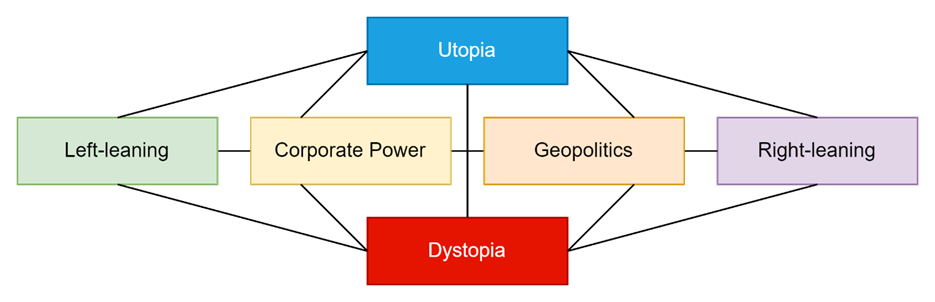
With something as complex as AI, it is naturally almost impossible to definitively boil this down to six narratives. We don’t pretend to do this. However, we believe the six AI narratives in Figure 1 captures the essence of the AI era we live in and provides a platform for further exploration, collaboration and decision-making behaviour.

Figure 1: Six AI Narratives

Source: Technology Connect*

The Utopian narrative envisions AI as a transformative force that will lead to unprecedented levels of prosperity, efficiency, and quality of life. Proponents believe AI will solve many of humanity’s biggest challenges, from healthcare to environmental sustainability, and usher in a new era of abundance and well-being. In this scenario singularity will happen in less than 25 years and the first people to live to 1,000 years old are already born.

In contrast is the Dystopian narrative, that warns of the potential dangers and negative consequences of AI. This perspective highlights risks such as mass unemployment, loss of privacy, and the possibility of AI systems becoming uncontrollable and harmful to humanity. In this scenario, humanity is in grave danger of destroying itself.

The Utopian and Dystopian narratives constitute the top and bottom sides of the AI Rubik’s cube, and the four middle sides are described below.

The Corporate Power narrative speculates that large technology companies, such as Apple, Alphabet (Google), Amazon, Meta (Facebook) and Microsoft, will become increasingly dominant and powerful, potentially surpassing the influence of large nation-states. This narrative highlight concerns about the concentration of power and control over AI technologies within a few mega-corporations. These companies have vast resources, data, and talent, enabling them to drive AI innovation and deployment at a scale that smaller entities cannot match. The narrative also raises questions about the implications for competition, privacy, and democratic governance, as these corporations could wield significant influence over global economies and societies.

The Geopolitical narrative focuses on the competition and strategic rivalry between nations and large trade blocs over AI dominance. This narrative is particularly concerned with the technological and economic race between the United States and China, as both countries invest heavily in AI to gain a competitive edge. It examines how AI is becoming a critical factor in national security, economic power, and global influence. The narrative also explores the potential for AI to exacerbate geopolitical tensions, lead to an arms race in AI technologies, and create new forms of cyber warfare and espionage.

The Left-leaning AI narrative emphasises the ethical implications of AI and its impact on social equity, humanity and climate. This perspective advocates for robust regulations to ensure AI systems are transparent, accountable, and free from bias and helping to combat climate change. It focuses on using AI to enhance public services, protect workers, and reduce inequality. In this narrative, AI has potential to be good for humanity, if we can agree on, and adhere to, collectively designed guardrails. However, for proponents of this narrative, AI is progressing uncomfortably fast.

The Right-leaning AI narrative emphasizes AI as a driver of global economic growth, national competitiveness, and free-market innovation. This perspective advocates for minimal government intervention, allowing market forces to guide AI development and adoption. It focuses on leveraging AI to optimise international trade, boost productivity, and enhance national security. In this narrative, regulation is not ignored, but perceived as something that needs to be of pragmatic nature and not constrain the desired fast pace with which new AI solutions can be commercialised.

Concepts, Language and Metaphors

Each of the above narratives are characterised by concepts, language and metaphors. Table 1 below provides a summary across the six AI narratives:

Table 1: Concepts, Language and Metaphors

Source: Technology Connect

Narratives are important input into scenario planning and strategy development, where an understanding of the external environment and driving forces are considered in combination with internal drivers such as corporate objectives, values and operating model. In this context, each narrative represents a scenario with opportunities and threats to companies’ future market position and profitability. Scenarios inform our thoughts of a perceived future and influence what investment decisions or strategic “bets” to place. Depending on which narrative, or combination thereof, a company considers most likely, key investment considerations includes:

In the Utopia narrative, heavy investments in R&D are required to be at the forefront of breakthroughs, including people, hardware and software. Proponents are preparing for rapid societal changes and new market opportunities. Investments will focus on sectors with major positive societal impacts such as healthcare and climate solutions.
In the Dystopian narrative, companies prioritise AI safety research and responsible development practices. Contingency plans are developed for AI-related crises and drives a resilience focus. As AI is expected to disrupt most jobs, reskilling programs are prioritised.

In the Corporate Power narrative alliances and partnerships are formed with the large tech companies or as a coalition outside of the tech companies to maintain competitiveness. The tech companies are expected to aggressively pursue AI to maintain a competitive edge alone and as a small group of global power players.

The Geopolitical narrative consider alignment of AI strategy with national interest and policies. It considers geopolitical risks in global AI deployment and explores collaborations with governments and defence agencies.

Left-leaning considerations prioritise ethical AI development and bias mitigation. AI application investments must consider social impacts and companies are preparing for stricter AI regulation and oversight.

Right-leaning considerations are naturally focused on AI applications to drive productivity and efficiency gains. Proponents of this narrative envision a more deregulated, market-driven AI landscape favouring accelerated AI investments to achieve first-mover advantages.

Where to from here?

Presenting the six AI narratives within an overarching framework provides a better sense of the nuances and effects of its ramifications and lays the groundwork for scenario planning, strategic investments and policies. Embracing difference, uncertainty, and tension instead of seeking to reduce AI into simple, one-way approaches to seeing, thinking and feeling, encourages dialogue, collaboration, co-design and “both/and”, rather than “either/or” thinking, to decide how AI can enhance our lives and not leave anyone behind.


If interested in exploring future AI scenarios as part of strategic planning or policy development, then connect with us.

* In writing this paper, we have taken inspiration from Anthea Roberts and Nicolas Lamp’s book: Six Faces of Globalisation – Who Wins, Who Loses, And Why It Matters (2021). A great read, especially if you wish to broaden your view on different globalisation narratives. Roberts and Lamp also use the Rubik’s cube as a metaphor for globalisation scenarios.

Tom Dissing is the founder and Managing Director of Technology Connect. He has deep expertise in helping companies digitally transform and scale their businesses through better, faster and smarter use of emerging technology and optimising value from ecosystems of supplier capabilities. Tom is a trusted advisor to procurement, technology and finance executives and senior management teams. He has advised senior executives in Financial Services (Banking, Insurance, Wealth and Superannuation), Media & Entertainment, Construction & Engineering, Technology Services and Government (Federal and State) in Australia, New Zealand, Asia and Europe.

Copyright © 2024 Technology Connect. All rights reserved.


Data & Analytics Strategy

Data & Analytics Strategy

by Tom Dissing

As data and analytics transform industries at a continuously faster pace, the strategies of leading companies offer a road map for success

Forty-seven percent of companies say that data and analytics have fundamentally changed the nature of competition in their industries in the past three years. Traditional competitors are 2.5x more likely to launch new data and analytics businesses, pooling data via a shared utility and forming data-related partnerships along the value chain (Note 1). Companies see the potential to reduce total annual costs by 33% and increase incremental revenue by 31% from using data they already have. Add those two numbers together, and the incentive to monetise data is clear: It could vastly boost the bottom line (Note 2).
Yet, despite these competitive changes and tangible financial opportunities, 4 in 10 companies say that their company is only responding in an ad hoc manner (Note 1). With 86% of businesses saying 2019 is the year in which they will extract value from data. The time to hesitate is over. The race is on!

Barriers to Success

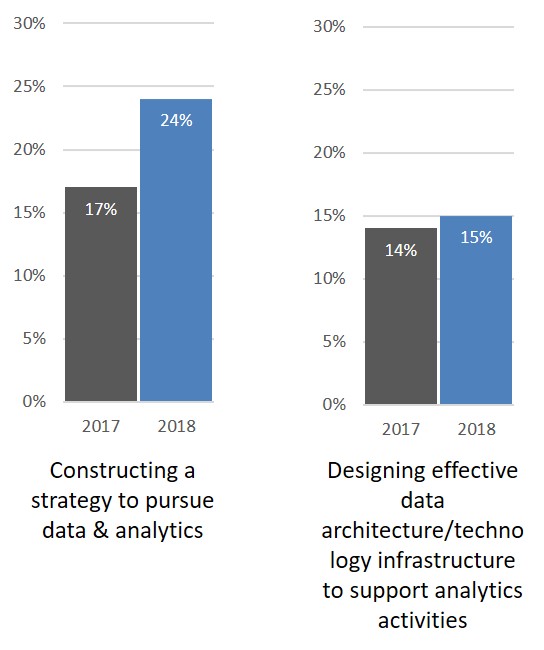
What are the challenges companies are facing to successfully implementing data and analytics initiatives? As illustrated in Figure 1, the two main barriers are lack of strategy and lack of architecture and technology infrastructure, with a lack of strategy increasing in importance as results requires a strategically coherent approach.


Figure 1: Barriers to Success


Source: McKinsey (Note 1)

These two barriers as well as ensuring senior management leadership of data and analytics efforts are also the key contributors to success. So, what can companies do to overcome these barriers and start to leverage them to become data-driven?

Data & Analytics Strategy

A comprehensive strategy is, of course, critical to success in nearly any business endeavour, and data and analytics initiatives are no different. Leading companies are creating data and analytics strategies.
A data strategy helps companies clarify the primary purpose of their data and guides them in strategic data management. Generally, there are three main strategic purposes of a data strategy:

  1. Increase revenue
  2. Improve operational efficiencies (e.g. cost, time and resource reductions)
  3. Monetising data (e.g. Weatherzone or FitBit selling their data to other companies)

Australian companies are primarily using data to generate revenue growth and cost efficiencies, whereas monetising data is viewed as a potential next level of sophistication and opportunities.
A data strategy should consider both the internal strategic drivers as well as the external environment. The latter being explored via customer research, industry trends, technology and data trends and leading data and analytics practices.
A data strategy should be focused on the target state and derived by considering the following:

  • Vision & Outcomes
  • Strategic Alignment
  • Customer & User Journeys
  • Capabilities & Architecture
  • Accelerators and Risks

The target state will require changes to the operating model, that should include the following five elements:

  1. Organisation
  2. Data & Processes
  3. Systems & Tools
  4. Engagement
  5. Governance

For insights into how to design a new operating model, refer to Technology Connect’s Operating Model Canvas as set out in the Next Generation IT Operating Model insights paper.

Finally, the data strategy needs an Execution Plan, which typically contains an Investment Case for the strategy, i.e. the costs and benefits over the strategic time horizon, and a detailed road map to ensure all components of the target state are sequenced correctly and allocated to key stakeholders proving the shortest path the highest value.

Data & Analytics Architecture and Technology Infrastructure

To execute the data and analytics strategy organisations typically need to invest in the deployment of a modern and scalable data architecture.

Cloud data warehouse solutions enable compute resources to be scaled with no effective limit. This enables dynamically spinning up new clusters, pay as you go (by the second) and simplifies capacity planning. There are plenty of Software as a Service (SaaS) data warehouse solutions available. A leading example is Snowflake, that also facilitates workload separation which solves the problem of multiple teams competing for shared fixed resources to run data queries. In other words, it reduces the time it takes to query the data warehouse for multiple teams. Essentially, Data Warehouse as a Service (DWaaS) enable organisations to quickly deploy a data warehouse prototype, including leveraging inbuilt and continuously updated workflow automation and security features. DWaaS also facilitates data sharing to and from multiple sources in a data eco-system, which traditionally has been a very expensive and time-consuming undertaking for many big data and analytics teams.

From an analytics perspective, there are several solutions that, when combined with a cloud-based data warehouse solution, can enable the insights for faster and better revenue growth and operational efficiency decisions. Solutions such as Qlik Sense and Tableau (now part of Salesforce) are examples of leading analytics solutions. Qlik’s recent acquisition of Attunity, a leading provider of data integration and big data management solutions, makes this a very exciting solution for a simplified, but modern architecture.

There are other components of a modern data and analytics architecture that will enhance the data and analytics capabilities, e.g. Alteryx to automate the data warehouse queries and data extracts and DataRobot to automate reporting to drive user self-sufficiency.

Creating a Data-driven Culture

In conjunction with a data and analytics strategy, leading companies are making data a core part of employee collaboration, engagements and mindsets by educating them as part of a broader effort to build a strong data-driven culture.

If you haven’t yet got a data and analytics strategy, it can be as simple as creating three to five use cases for how data that you already have can improve your operational efficiency. This should be followed by a prototype to incorporating your use cases. The prototype will allow you to build momentum and prove the tangible benefits of being a data-driven organisation.

Notes:

  1. McKinsey: Catch them if you can: How leaders in data and analytics have pulled ahead, 2019
  2. PwC Data Trust Pulse Survey, 2019

If you are interested in an assessment of your company’s Data & Analytics Pulse as an input into developing your Data & Analytics Strategy or compare your organisation to peers, then click on the following link to a secure Microsoft Form Survey. The survey takes approx. 10 minutes to complete. Your response will remain confidential: Data & Analytics Pulse Survey

For additional insights and ideas: technologyconnect.com.au

or follow us on LinkedIn via: linkedin.com/company/technologyconnect


Tom Dissing is the founder and Managing Director of Technology Connect. He is a certified Data & Analytics Master with deep expertise in guiding medium and large organisations on their digital transformation journeys as they re-imagine and scale their businesses in response to the disruptive challenges and opportunities of the 4th Industrial Revolution. He has advised senior executives in Financial Services (Banking and Insurance), Media & Entertainment, Construction & Engineering, Technology Services and Government (Federal and State) in Australia, New Zealand, Asia and Europe.

Copyright © 2019 Technology Connect. All rights reserved.


Next Generation IT Operating Model

Next Generation IT Operating Model

By Tom Dissing

A mindset shift is required to design and transform the IT Operating Model to effectively support the digital business strategy ambition

Nine out of 10 companies are unable to execute their digital strategies (Note 1). Not through a lack of trying, but from a fundamental disconnect between strategy and execution. This is caused by not evolving and aligning the IT Operating Model to the digital transformation strategy. Unpacking this problem reveals that the design and transformation of an IT Operating Model is far more complex than anticipated and that it cannot be done without a radical shift in mindset. The mindset required includes a data-first approach and new ways of working.

Digital Ambition

In a constantly changing business environment, IT knows that it has to change. Business users are increasingly sourcing and provisioning technology solutions, thereby changing how IT adds value. Customer expectations and interactions are rapidly moving to real-time data and automated responses based on machine learning and artificial intelligence. Progressive technology teams are asking themselves strategic questions such as:

  1. Does our current IT Operating Model support our company’s digital ambition?
    Does it give us the agility, speed and innovation required to win in the market?
  2. However, most organisation have identified a misalignment between their digital business strategy and IT Operating Model. As a result, 60% of companies are in the process of, or planning to complete, a major transformation of their IT Operating Model (Note 2).

IT Operating Model

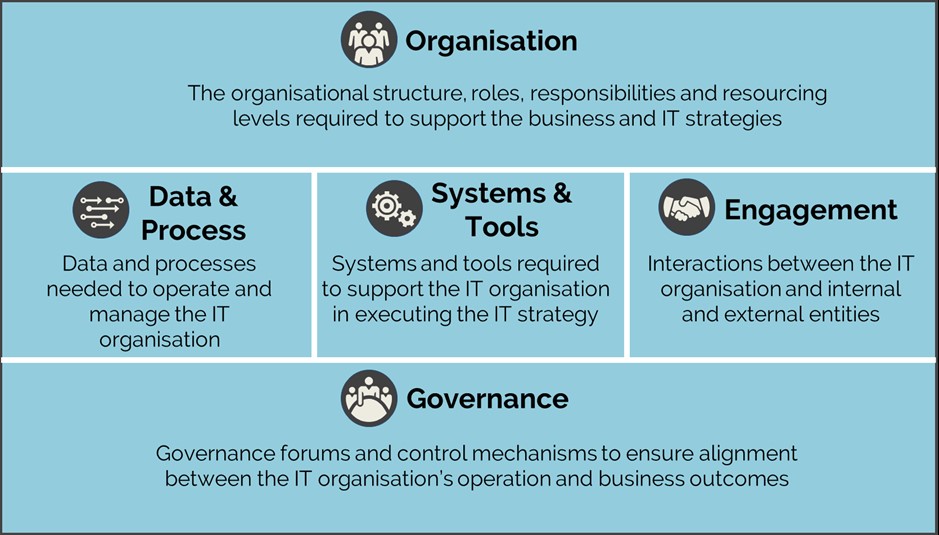
An IT Operating Model describes how IT capabilities are delivered to successfully execute the IT and business strategy. Essentially, it is “how we do things around here” and contains 5 interconnected elements illustrated via the IT Operating Model Canvas in Figure 1.

  1. The Organisation element describes the structure, roles, responsibilities and resourcing required to support execution of the IT strategy.
  2. The Data and Process element includes the data and processes needed to operate and manage the organisation.
  3. The Systems & Tools element considers the IT systems and tools (not the enterprise applications) to support the IT organisation in executing the IT strategy.
  4. The Engagement element deals with the interactions between the IT organisation and internal and external stakeholders.
  5. The Governance element describes the various decision-making forums and control mechanisms to ensure alignment between the IT organisation’s operation and business outcomes.
Figure 1: IT Operating Model Canvas

Source: Technology Connect

A New Mindset

Two elements in the Operating Model Canvas drive the new mindset required for IT:

  • Data – there needs to be a data-first approach in designing the new Op Model. This is in contrast to the traditional process-first approach typically found in analogue businesses, e.g. ITIL or ISO 20000. A data-first approach means that you ask yourself: What data do we need to provide this service? (as opposed to: What processes do we need to deliver this service). A data-first approach is fundamental for agility and scalability. Processes remains part of the Op Model Canvas as the ITIL framework is very useful in making sure that all areas of IT are covered. It is also important to note that we’re not advocating for ‘no processes’, but that the approach is data-first in a process framework context.
  • Design Thinking – involves integrating new ways of working centred on agile practices, collaboration and transparency with a focus on customer and user journeys.
    Effective application of design thinking requires the right facilities such as open space, natural light, colours and collaboration tools. At Technology Connect, we call it the Transformation Hub – a place where everyone collaborates and innovate to make a difference.

In and by themselves, these two elements may not be considered new. However, the combination of data-first and design thinking is new to many organisations. Often, these are executed in silos or sequentially in problem solving scenarios. They need to be applied simultaneously to leverage the strengths of both perspectives to accelerate the time to value for IT users.

Strategic Alignment

Re-imagining the IT Operating Model will not bridge the gap between business strategy and execution unless two other important areas are in place:

  1. A Digital Business Capability Model that defines all of the capabilities required to operate the business. It also needs to identify the differentiating capabilities, i.e. the capabilities that will enable the company to “win” in the market
  2. An IT Strategy to set the direction for how IT will support the organisation to achieve its strategic objectives and positions IT as an enabler of transformational change and business growth. This includes the various IT blueprints, e.g. infrastructure, applications and integration.
    The above two aspects guide the IT Operating Model. Orgnisations that try to develop an IT Operating Model without these are finding it very difficult to practically demonstrate how the new operating model will support the digital business strategy.

Where to Start?

If you haven’t started to re-imagine and transform your IT Operating Model it is often useful to identify the “trigger” or “burning platform” necessitating this change, e.g. a change in business strategy, a mergers and acquisition (M&A) scenario or an investment in a new technology platform. The “trigger” act as a catalyst for change and a shared purpose.

Notes:

  1. Gartner, Redesign Your IT Operating Model to Accelerate Digital Business, October 2018
  2. The remaining 40% have either completed their IT Operating Model transformation or are not considering or planning any such change.

If interested in a proven, structured and accelerated process to re-imagining your IT Operating Model in support of executing of your digital business strategy, or to explore transformation ideas via a facilitated workshop in our Transformation Hub space, why not connect with us on info@technologyconnect.com.au?

The future is yours – if you want it!

Tom Dissing is the founder and Managing Director of Technology Connect. He has 15 years of executive management experience in large scale digital transformations and maximising value from emerging and disruptive technology investments. He has advised senior executives in Financial Services (Banking and Insurance), Media & Entertainment, Construction & Engineering, Technology Services and Government (Federal and State) in Australia, New Zealand, Asia and Europe.

Copyright © 2019 Technology Connect. All rights reserved.